Understanding
Pigmentation: A Diagnosis-
Led Approach
Why an accurate diagnosis - not a generic peel or laser - is the starting point for
treating pigmentation on Indian skin.
Almost every patient who comes to us for pigmentation has already tried something - a cream picked up at a pharmacy, a peel done elsewhere, sometimes a laser session that made things worse before they got better, if they got better at all. The pattern is familiar: pigmentation is treated as a single problem with a single fix, when in reality "pigmentation" is a description of what you see, not a diagnosis of what's happening underneath.
Pigmentation Is Not One Condition
Several distinct conditions can look similar to the eye but behave very differently under treatment:
✓ Melasma – patchy, symmetrical pigmentation, often on the cheeks and upper lip, closely tied to sun exposure and hormonal triggers. It is prone to worsening with heat or aggressive procedures.
✓ Post-inflammatory hyperpigmentation (PIH) – pigmentation left behind after acne, injury or inflammation, common on Indian skin and easily made worse by procedures chosen without care.
✓ Sun-induced pigmentation – freckling and uneven tone from cumulative UV exposure,
generally more stable and more responsive to standard treatment.
✓ Vitiligo – the opposite process, a loss of pigment rather than an excess of it, and a reminder
that “even-toned skin” covers more than one underlying biology.
Each of these needs a different treatment logic. Applying one plan to all of them is the single most common reason patients tell us a previous treatment "didn't work" - or made things worse.
Why Indian Skin Needs a Different Approach
Most Indian skin falls into the deeper end of the Fitzpatrick scale, which means it carries a higher density of active melanocytes - the cells responsible for producing pigment. This is exactly why our skin is more prone to post-inflammatory hyperpigmentation: any procedure that triggers inflammation, if not calibrated for the skin type in front of it, can trigger a fresh wave of pigment rather than clearing the old one.
A chemical peel or laser setting that works safely on lighter skin can be too aggressive here. This is not a reason to avoid these treatments - many are genuinely effective - but it is the reason they should never be chosen off a menu. The strength, depth and device need to match the skin in front of the specialist, not a standard protocol.
"Pigmentation" describes what you see. It is not, by itself, a diagnosis of what's happening underneath - and treating the description instead of the cause is how most pigmentation treatments fail.
What Diagnosis-Led Treatment Looks Like
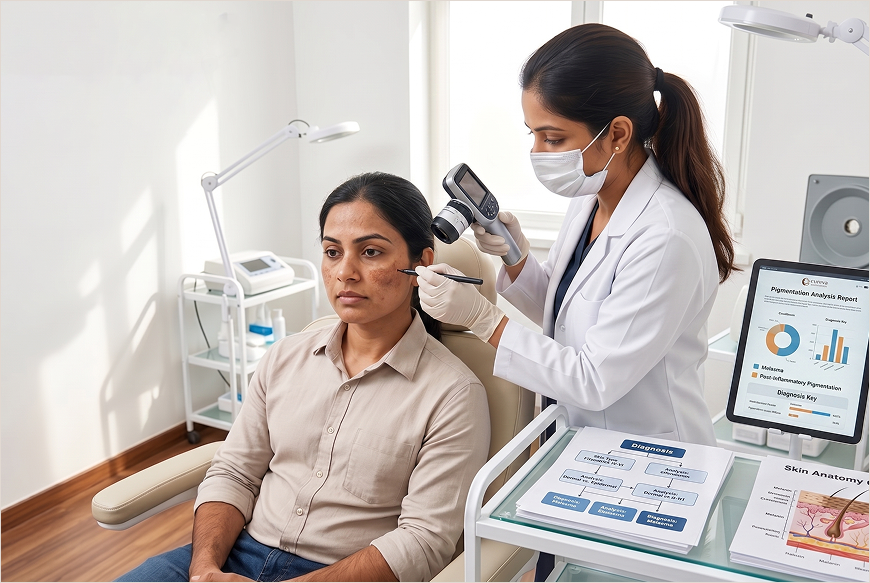
Before any product or procedure is recommended, a proper pigmentation consultation should answer three questions: what type of pigmentation this is, how deep it sits in the skin, and what is actively triggering or maintaining it.
✓ History-taking – sun exposure patterns, hormonal factors, medication use, pregnancy history and prior treatments attempted.
✓ Dermoscopic and Wood’s lamp examination – to assess whether pigment sits in the epidermis, the dermis, or both, which materially changes what will respond to treatment.
✓ Pattern assessment – distinguishing melasma from PIH, sun damage or other pigmentdisorders that can coexist on the same face.
Only once this picture is clear does it make sense to talk about specific treatments - and, just as importantly, which treatments to avoid for this particular patient at this particular time.
Matching Treatment to Diagnosis
Treatment for pigmentation is rarely a single step. Depending on the diagnosis, a plan may draw on:
✓ Topical depigmenting agents – often the foundation, and sometimes sufficient on their own for epidermal pigmentation.
✓ Chemical peels – selected and staged carefully, since the wrong depth or frequency is precisely what triggers PIH on deeper skin tones.
✓ Daily sun protection – non-negotiable in any pigmentation plan; without it, even the right
treatment will underperform.
✓ Laser and energy-based treatments – used selectively, with settings adjusted for skin type, and sometimes deliberately avoided when the risk of rebound pigmentation is high.
Most plans are staged and monitored rather than delivered as a single session, with the approach adjusted as the skin responds - which is only possible when the starting diagnosis was accurate to begin with.
A Note on "Quick Fix" Treatments
Aggressive, undiagnosed treatment is the most common cause of pigmentation getting worse rather than better on Indian skin. If a treatment is recommended before your skin has actually been examined, that's worth questioning.
When to See a Specialist
It's worth booking a proper consultation - rather than trying another over-the-counter product or walk-in peel - if pigmentation is spreading, darkening, resistant to consistent sun protection, or if you're considering a peel or laser and have a history of pigmentation worsening after previous procedures. Pregnancy-related melasma also deserves its own conversation, since treatment options and timing differ during and after pregnancy.
Getting the diagnosis right the first time is almost always faster, and safer, than working backward from a treatment that didn't match the condition it was meant to fix.
Concerned about pigmentation that isn't responding, or unsure which type you're dealing with? Start with a diagnosis-led consultation.
Dr. Sneha Rathi
Consultant Dermatologist & Aesthetic Physician, Cureva Aesthetics
Provides diagnosis-led care for skin, hair, scalp and nail disorders, along with personalised non-surgical aesthetic planning for skin quality, pigmentation, acne scars and healthy ageing.